



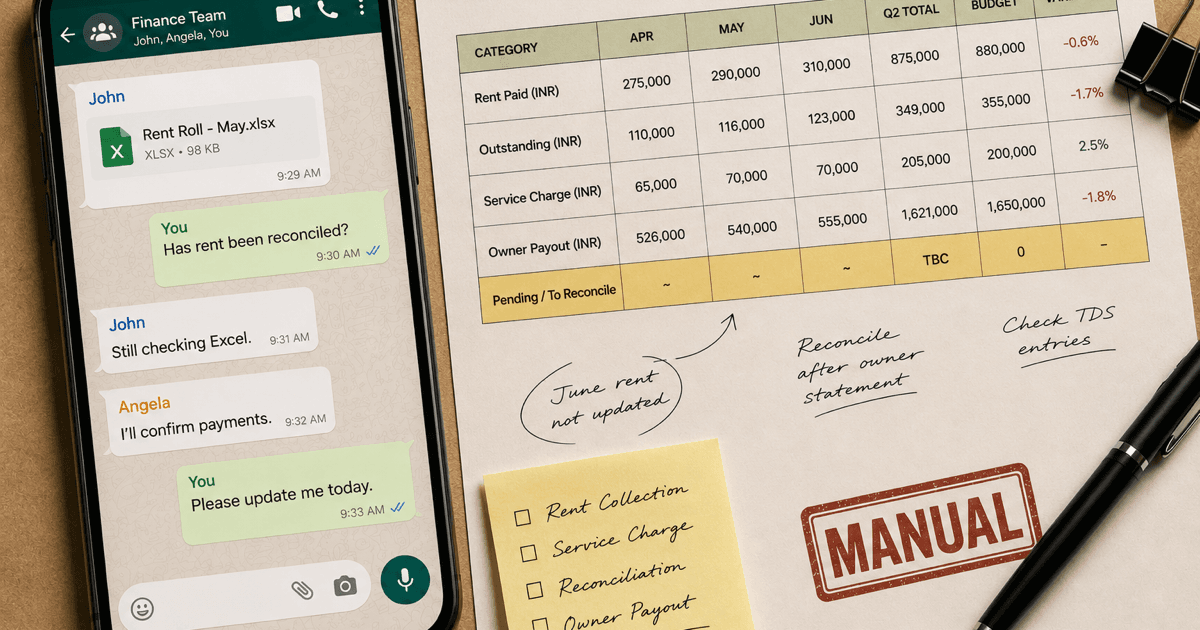
Property managers built entire operations on WhatsApp threads, spreadsheets, and manual workarounds. That happened for a reason, and that reason is finally disappearing.
Somewhere right now, a property manager is running a portfolio of thirty units from three tools: a WhatsApp group for tenant communications, an Excel spreadsheet tracking rent payments, and a notes app for maintenance issues. There is also a Gmail thread that functions as an unofficial CRM, a folder of scanned receipts that functions as an unofficial accounting system, and a second spreadsheet that exists because the first one got too complicated.
This is not a story about a property manager who doesn't know what software is. It is a story about an industry that software largely forgot, and the property managers who built workarounds so effective they stopped noticing they were workarounds.
The WhatsApp Operating System
Property management runs on informal infrastructure in a way that almost no other professional service does.
The average property management firm runs across 12 to 15 different software systems. Independent landlords and small portfolio managers, who represent a large share of rental ownership in many markets, often run on nothing purpose-built at all. Tenant messages go to WhatsApp. Payments come in via bank transfer and get manually reconciled. Service charges get calculated once a year in a spreadsheet that somebody built four years ago and nobody fully understands. Owner statements get assembled by hand, one landlord at a time, at the end of each month.
Property managers spend an average of 3.1 hours per owner per month just assembling and delivering reports. For a firm managing twenty owners, that's 62 hours of monthly overhead, before a single property issue has been dealt with.
The tools are free. The cost is invisible. And because the cost is invisible, it compounds for years without anyone adding it up.
Why Every Other Industry Got There First
B2B software transformation usually follows a predictable path: an industry gets fragmented enough to hurt, a venture-backed platform spots the opportunity, and within a decade the old way looks embarrassing. Logistics got Kobo360. Restaurants got Moniepoint and ORDA. Healthcare got a generation of vertical SaaS that rebuilt clinical workflows from the ground up. Freight invoicing, dental practices, HVAC businesses, legal firms, all of them got purpose-built software before property management did.
The reason property management was last is structural.
Software companies go where the money is concentrated. A restaurant chain with two hundred locations is one sales call. Two hundred independent landlords with one property each are two hundred sales calls, each one harder to close because the buyer is also managing a broken water heater, a late rent payment, and ten other things that matter more than a demo.
The long tail of the property market, where most rental properties actually sit, was hard to serve. Independent property managers, letting agents, and private landlords operated across a highly fragmented market, making them difficult for software companies to reach and sell to at scale. So enterprise proptech companies went upmarket. They built for institutional portfolios and large property owners, where the contracts were large enough to justify the cost of sales. Everyone else stayed on WhatsApp.
What Kept Proptech Stuck
It wasn't just the fragmentation. Property management also has a particular conservatism that comes from the stakes involved.
When you are handling other people's money, collecting rent on behalf of landlords, holding service charge funds in trust, managing payouts that affect people's income, the tolerance for a system that "mostly works" is surprisingly high. A broken CRM is an inconvenience. A broken rent ledger is a liability. The spreadsheet everybody complains about is also the spreadsheet nobody will replace until they're completely certain the replacement won't lose a payment or misallocate a charge.
This is rational caution. It is also the reason the industry stayed on tools built for other purposes long after better options existed.
Why 2026 Feels Different
Two things changed, and they changed at the same time.
The first is cost. The infrastructure required to build a proper financial platform for property management, payment rails, automated reconciliation, multi-party disbursements, became dramatically cheaper. What used to require a fintech team of forty can now be assembled by a small team that understands the domain.
The second is trust. The number of property management companies using automation tripled in a single year, from 20% to 58%. The early adopters proved that purpose-built software doesn't lose payments or misallocate charges, it prevents those things from happening. The case studies exist now. The fear is lower.
The informal infrastructure of WhatsApp threads and reconciliation spreadsheets persisted because the alternative was either unaffordable or unproven. In 2026, it is neither.
The Last Industry Standing
The honest version of this article ends with a provocation: property management was not left behind because the people in it were resistant to technology. It was left behind because the technology industry did not build for them until recently.
The workarounds they built, the WhatsApp groups, the spreadsheet systems, and the manual reconciliation routines were signs of resourcefulness in the absence of infrastructure.
The infrastructure exists now. And the property managers who adopt it are not upgrading their tools. They are getting, for the first time, tools that were actually built for them.
Estate Manager
Put the work behind your portfolio in one clear view.
Keep every part of your portfolio connected, visible and easier to run.