

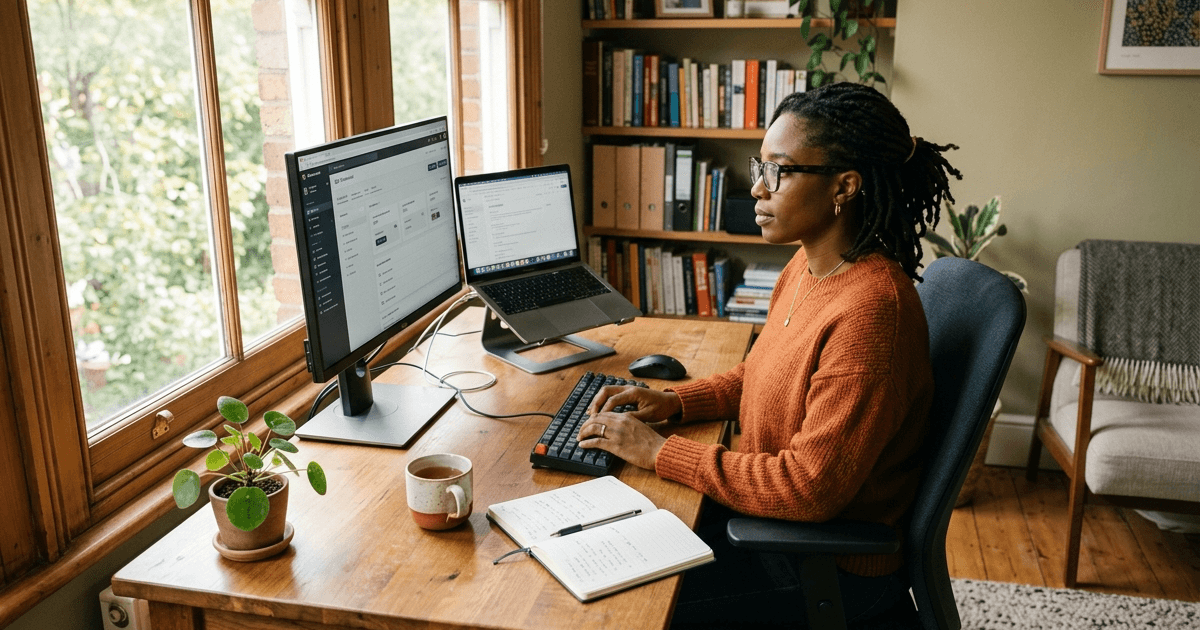
The tenant profile has shifted. Many renters now need a home that can carry a working day, and most property listings are still marketing the old requirements.
The pandemic ended. Remote work didn't.
Five years on, hybrid arrangements have stopped feeling like a temporary experiment and started feeling like a permanent feature of working life. Over half of remote-capable workers are now in hybrid roles. A meaningful share never went back at all. And somewhere in that shift, the requirements of a good rental property changed quietly, and largely unnoticed by the people managing them.
Here's what changed: the home is no longer where you go after work. For a large segment of renters, it is where work happens. That sounds simple. Its implications for property management are not.
The tenant who needs a home to sleep in is a different product requirement from the tenant who needs a home to work in. One needs a bed, a functioning shower, and proximity to a train station. The other needs all of that plus reliable broadband, a room they can close a door on, and enough space that their laptop is not competing with the kitchen table. Most of the rental market is still selling the first thing to people who need the second.
What Remote Work Actually Changed
It changed the geography of demand. Tenants who once paid a city-centre premium for commute proximity are now paying that premium for space, and finding it in places that used to sit at the bottom of their shortlist. Mid-sized cities, suburban neighbourhoods, and quieter towns are seeing sustained demand they had not seen before. Not because they are suddenly fashionable. Because they have square footage.
It changed the length of tenancies. A tenant who chose a flat based on commute proximity will move when the commute changes. A tenant who chose a flat because it has a proper home office, a garden, and broadband that does not drop in the afternoon is less quick to leave. Tenants working from home can stay longer, not because they are particularly loyal, but because the switching cost is higher. They have built their working life around the property, not just their social one.
It changed what tenants notice. Bad broadband used to be an inconvenience. For a remote worker, it is a reason to reconsider the lease. A spare room presented as storage rather than a home office is a missed opportunity that shows up directly in demand. The property manager who can articulate the working life a property enables is not just listing a unit. They are selling the day the tenant actually lives.
What Most Listings Still Miss
Still listing properties by bedroom count and commute time. Still photographing the kitchen first. Still defining a "good tenant" by employment status, without considering whether that employment means they will be at home eight hours a day. Still pricing properties the way the market prices them, without understanding that the market has not caught up to what remote workers will actually pay for the right setup.
The pattern is clear. Properties that actively cater to remote workers, with dedicated office space, fast internet listed as a feature, and flexible lease terms, can fill faster and turn over less. This is not a marginal difference. It is the kind of gap that shows up clearly across a portfolio, once you know what you are looking at.
The Property Manager's Actual Job Here
It is not to redesign every property in the portfolio. It is to understand what you are managing and market it accordingly.
A spare bedroom is either a spare bedroom or a home office. One of those attracts more interest, commands more stability, and gives you a story to tell at listing. A broadband speed is either an unmentioned utility or a headline feature. Flexible lease terms are either a concession or a competitive advantage. None of this requires capital expenditure. It requires a different frame.
The property managers already operating this way, who understood that the tenant profile shifted five years ago and has not shifted back, are running lower vacancy rates and higher retention. They are not doing it by being better at property management in the traditional sense. They are doing it by having noticed something most of the industry has not.
The tenant who works from home is not a niche anymore. They are a normal part of the rental market. The landlords and managers who understood that early are not scrambling to adapt. Everyone else is.
Estate Manager
Put the work behind your portfolio in one clear view.
Keep every part of your portfolio connected, visible and easier to run.